
Please Call Before Collecting
£33.50 ex. VAT
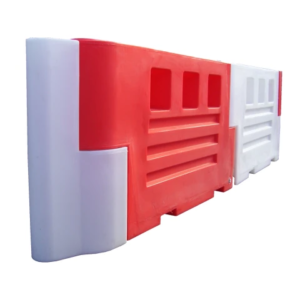
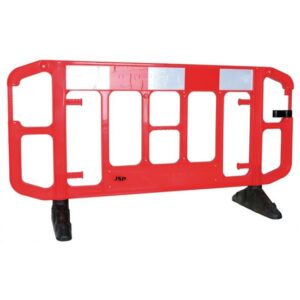
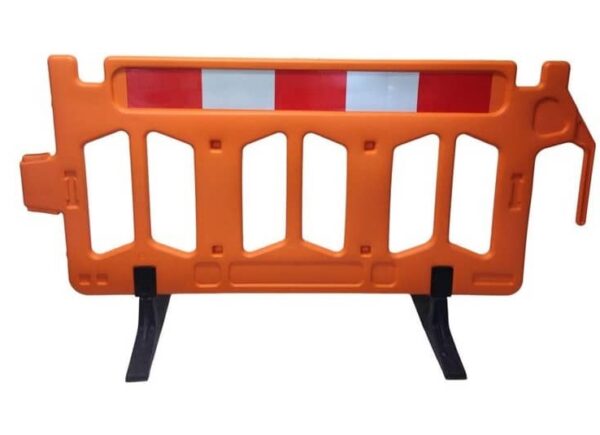
The Chapter 8 Barrier is a 2m (L) x 1m (H) plastic traffic management barrier built for roadworks, excavations and pedestrian segregation. Moulded from tough, UV-stable HDPE, it carries an integral red and white reflective Chapter 8 strip and meets the requirements of BS 8442, with reflectivity to BS EN 12899-1. Each barrier interlocks via linking pins to form continuous runs, and the 360° anti-trip feet fold flat for compact stacking and transport. Lightweight enough for single-person handling, it’s a reusable, compliant choice for highways, construction sites and events.
When you’re closing off a footpath, guarding an excavation or guiding pedestrians safely past a work zone, the barrier you choose has to do two jobs at once: keep people out of harm’s way and keep you on the right side of the rules. This Chapter 8 Barrier does both.
It takes its name from Chapter 8 of the Traffic Signs Manual, the Department for Transport’s guidance on signing and guarding temporary works on or near the public highway. The integral red and white reflective banding is what makes the barrier instantly recognisable to drivers and pedestrians, day or night.
Because each unit arrives as a single moulded piece, there’s nothing to assemble. Drop it in place, link it to the next one and your run is ready. When the job’s done, the feet rotate flat so the barriers nest together for storage and transport, so you’re not paying to haul fresh air between sites.
| Specification | Detail |
| Length | 2m (2000mm) |
| Height | 1m (1000mm) |
| Material | High-density polyethene (HDPE), UV stabilised |
| Reflective banding | Integral red & white Chapter 8 strip |
| Feet | 360° rotating anti-trip feet (folds flat for storage) |
| Connection | Interlocking linking pins |
| Weight | Approx. 12kg |
| Standards | Meets requirements of BS 8442; reflectivity to BS EN 12899-1; in line with Chapter 8 of the Traffic Signs Manual |
Getting temporary traffic management wrong can mean fines, project delays and, far more importantly, people getting hurt. This barrier is built to the references contractors and local authorities expect: it meets the requirements of BS 8442, the reflective banding conforms to BS EN 12899-1, and the design follows the principles set out in Chapter 8 of the Traffic Signs Manual.
Most plastic Chapter 8 barriers share the same connection principle, so they’ll usually link to an existing stock. Fit can vary slightly between manufacturers, though, if you’re mixing brands across a single run, it’s worth ordering one to test the join before committing to a full set.
For typical pedestrian and low-speed segregation, the anti-trip feet provide the stability you need. On exposed sites or near faster-moving traffic, wind loading becomes a real factor, so plan for additional ballast or backstays as your risk assessment dictates rather than relying on the feet alone.
We don’t sell spare parts for these barriers; they’re supplied as a complete unit. There’s little to go wrong, though: the reflective strip is moulded into the body rather than stuck on, so it won’t peel off, and the one-piece HDPE build is made to take knocks and stay in service for years.
No single product makes a site Chapter 8 compliant on its own; compliance comes from the whole layout, including signage, lighting and walkway widths. Think of this barrier as a compliant component around which you build the scheme, guided by your own risk assessment.
The UV-stabilised HDPE is made to live outside and take repeated knocks and handling, which is why these barriers suit hire fleets that are out in all weathers year-round. A quick rinse to keep the reflective banding clean and visible is realistically all the upkeep it needs.
Yes, it’s designed for exactly that, alongside private sites and events. Just remember that works on or near the highway also need the correct permits, signing and a layout that follows Chapter 8, so the barrier is one element of a properly planned scheme.


Reviews
There are no reviews yet.