
Please Call Before Collecting
Heavy-duty galvanised steel barriers • Interlocking design for secure connections • 2.3m standard length • Portable & stackable for easy transport & storage • Powder-coated options available • Ideal for crowd management at events, construction sites, pedestrian walkways, queues, roadworks & temporary fencing • High visibility & durable • Quick setup & removal
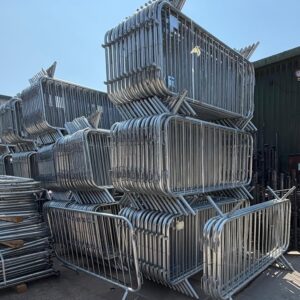
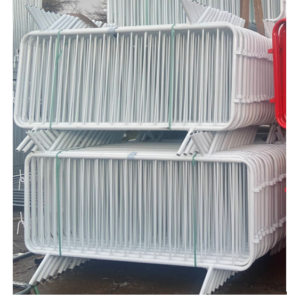
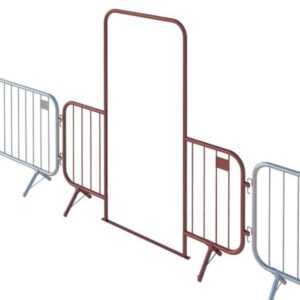
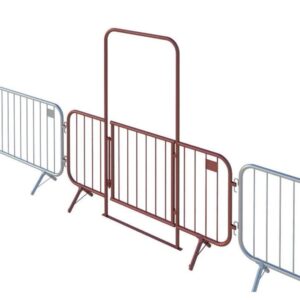
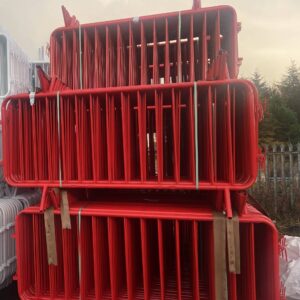
At Mays Direct, we supply a comprehensive range of crowd barriers designed to deliver reliable crowd management and effective perimeter control. With extensive experience supporting events, construction sites, roadworks, and public spaces across the UK, our barriers combine robust construction with practical, user-friendly design.
Manufactured primarily from galvanised steel, they offer excellent corrosion resistance and long-term durability, making them ideal for both temporary installations and repeated use in demanding environments. The integrated interlocking system enables fast, tool-free assembly into secure runs, while stackable designs simplify storage and transportation.
Whether managing pedestrian flow at festivals, securing work zones, or organising queues, our crowd barriers help meet UK safety standards while improving site efficiency. Choose Mays Direct for dependable performance, competitive pricing, and responsive local service you can trust.
Pedestrian or crowd barriers are portable, galvanised steel panels that interlock to form secure boundaries, guiding foot traffic and separating people from hazards or restricted areas.
Yes, the terms are used interchangeably. Both describe the same modular steel barriers designed to control pedestrian movement, whether for everyday walkways or high-density crowd situations.
Construction sites, roadworks, outdoor events and festivals, public markets, car parks, queuing areas at venues, retail spaces, and any location requiring temporary pedestrian routing or perimeter control.
Our fixed leg barriers feature heavy-duty construction with thicker-gauge steel legs, providing superior freestanding stability and resistance to crowd pressure or accidental impacts, ideal for busy construction sites, roadworks, or lively public events in the UK.
The fixed leg model stands out as heavy-duty due to its reinforced 1.2mm gauge legs and solid build, offering extra resilience where standard options may suffice for lighter duties. Other variants feature strong galvanised steel frames suitable for most professional uses.
Galvanisation provides excellent rust protection, while optional powder-coating adds further durability and colour options. Proper storage after use extends service life across multiple seasons.
The hook-and-eye design enables rapid, secure linking without tools, creating continuous, stable barriers that resist displacement, which is essential for adequate crowd flow and perimeter security.
Most stock items are ready for nationwide delivery in 2–5 working days or immediate collection from our West Sussex location. We advise early ordering during busy periods to guarantee availability.
Yes, our team can help calculate the number needed based on your site dimensions, expected footfall, and access requirements. Contact us for tailored recommendations and bulk pricing.
No single mandatory UK-wide standard applies universally to all pedestrian or crowd barriers. Their selection, installation, and use must instead support compliance with relevant health and safety legislation, depending on the application:
In all cases, conduct a site-specific risk assessment, select appropriate barriers for expected loads/conditions, and ensure correct installation, regular inspection, and maintenance. Reputable suppliers can advise on alignment with the relevant requirements for your use.
Consider the site environment and duration of use, ground conditions, required stability (e.g., heavy-duty fixed-leg for high pressure), visibility needs (colour options), total length required, connection compatibility, storage/transport practicalities, and any site-specific risk assessment findings.
Installation is straightforward and tool-free:
Measure the total length of perimeter or queuing area you want to cover, then divide by the effective length per barrier (typically ~2.3m, but allow extra for corners, overlaps, and gates). For example, a 50m straight run needs about 22–23 standard barriers. Add 10–20% more for curves, entry/exit points, or contingencies. Our team can help with a quick site calculation.
Yes, but stability improves with: fixed-leg designs (better inherent balance), additional ballast (plates/sandbags), or foot extensions on loose-leg types. Avoid very soft/muddy conditions without reinforcement; risk of tipping under load. For frequent soft-ground use, consider barriers with wider feet or consult us for site-specific advice.