
Please Call Before Collecting
£451.00 ex. VAT
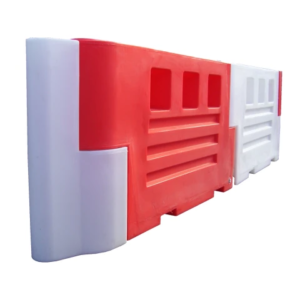
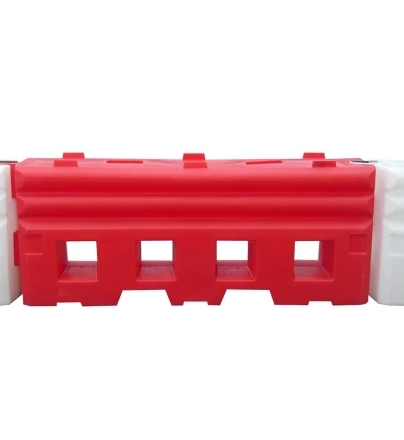
The RB22 is a one-piece, water-filled crash barrier that keeps vehicles away from your workforce and the public. Each unit measures 2m long, 800mm high and 500mm deep, weighing 60kg empty and around 600kg once filled. Moulded from UV-stabilised polyethylene in high-visibility red and white, it interlocks with steel pin hinges to form a continuous run. Crash-tested free-standing to 50mph (80km/h) under BS EN1317-N1, it brings a wayward vehicle to a controlled stop. Forklift slots are built in. Made in the UK.
When traffic and people share the same space, a soft cone or a lightweight bar barrier isn’t enough. The RB22 is built for the jobs where a vehicle could actually leave the carriageway, live highways, fast-moving site entrances, and any work zone where the consequence of a strike is serious.
Each barrier is a single moulded shell rather than a welded or bolted assembly, so there’s nothing to fail along a seam. Empty, it’s light enough for two people to position by hand; filled with water, it carries around 600kg of ballast, and that mass is what absorbs and redirects an impact instead of letting the vehicle through. Because the units hook together with a steel pin hinge and support plates, a row of RB22s behaves as one connected line rather than a series of loose blocks.
The red-and-white moulding stays visible day and night and won’t rust, rot or need repainting. The polyethylene is UV-stabilised, so it holds up to long outdoor deployments without going brittle or fading quickly. After an incident, an undamaged barrier can simply be drained, unhooked, stacked and used again, there’s no write-off cost for a clean hit.
The RB22 suits any setting where vehicles and people need to be separated with real protection behind it:
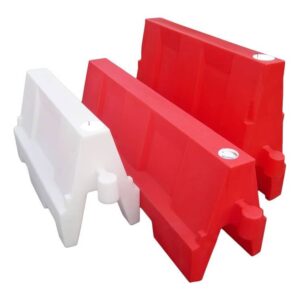
For projects that don’t require a 50mph crash-tested barrier, consider our RB2000 water-filled road safety barrier. It’s an excellent choice for traffic management, pedestrian segregation, and temporary site safety when a durable, water-filled barrier is needed.
Set each barrier in position, link them with the steel pin hinge and support plates, then fill through the opening on top. Fit any end sections, gates or anti-climb accessories once the run is in place. No deployment tools needed.
| Specification | Detail |
| Condition | New |
| Length | 2m (2000mm) |
| Height | 800mm |
| Depth | 500mm |
| Weight (empty) | 60kg approx. |
| Weight (filled) | 600kg approx. |
| Material | UV-stabilised polyethylene |
| Colour | Red and white |
| Impact tested | Up to 50mph (80km/h) |
| Standard | BS EN1317-N1 |
| Handling | Forklift slots |
| Country of origin | United Kingdom |
Yes. The protection comes from the ballast weight; empty, a 60kg shell offers little resistance to a moving vehicle. Filled to around 600kg, it provides the mass needed to absorb and redirect an impact. Treat an unfilled barrier as a visual marker only until it’s filled on site.
The polyethylene flexes more than a rigid container, but standing water can still freeze in a hard frost and put pressure on the shell. For winter deployments, many users add a salt or antifreeze solution to lower the freezing point. If you expect prolonged sub-zero conditions, ask us about the right mix before filling.
Each RB22 covers 2 linear metres, so divide your required length by two; a 20m run needs 10 barriers. If your layout turns a corner or needs a defined start and finish, factor in angle sections and safety barrier ends on top of the straight-run count.
No, the price is for a single barrier unit. End sections, angle pieces, anti-climb panels and gates are separate items that build onto the system.
Yes. Once emptied and unhooked, the barriers stack for compact storage, and the moulded forklift slots let you move them by machine rather than by hand. This is what makes them practical to redeploy across multiple jobs.
A single filled barrier is self-supporting, but the system is designed to perform as a connected line. Interlocking the units with the steel pin hinge spreads impact load across the run, which is how the 50mph crash-test performance is achieved. For protective use, always link your barriers.
Looking for more road safety equipment? Explore our complete range of traffic management products, including road barriers, water-filled barriers and pedestrian safety solutions for construction sites, roadworks and public spaces.

Reviews
There are no reviews yet.