
Please Call Before Collecting
£8.50 – £9.50Price range: £8.50 through £9.50 ex. VAT
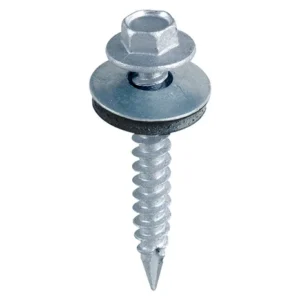
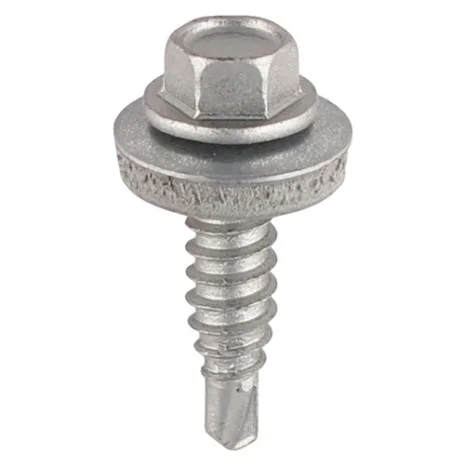
These 6.3mm self-drilling Tek screws are made for joining one metal sheet to another, typically at the side and end laps where corrugated roofing sheets overlap. Available in 22mm and 25mm lengths, each one has a hardened 3-point drill tip that bites straight through a combined thickness of up to 1.6mm without a pilot hole, plus a bonded EPDM washer that seals the hole watertight once driven home. Supplied in boxes of 100 with an exterior-grade corrosion coating and an 8mm hex head, they’re built to BS EN ISO 10666 and CE marked for roofing and cladding work.
Not every Tek screw is interchangeable, and using the wrong one is one of the most common mistakes on a roofing job. Sheet-to-timber screws are designed to keep cutting once they’ve passed through the metal and into the wood beneath. Drive one through two layers of metal instead, and the drill point burns out before it’s gone anywhere, leaving you with a screw that’s spun its thread and a hole that’s no longer sealed properly.
This screw is built for the opposite job: cutting through metal on both sides of the joint and stopping there. The shorter length reflects that there’s no need for the extra reach a timber screw needs to bite into a purlin, just enough thread to clamp two overlapping sheets together tightly and let the washer do its job.
However, if you need to fix roofing sheets to wood instead of metal. View our sheet-to-timber Tek screws for a fixing solution designed specifically for wooden applications.
| Spec | Detail |
| Diameter | 6.3mm |
| Length | 22mm or 25mm |
| Head type | Hex head, 8mm A/F |
| Drill point | Self-drilling, 3-point |
| Washer | Bonded EPDM, 8mm |
| Maximum combined thickness | 1.6mm |
| Coating | Exterior-grade corrosion-resistant |
| Standard | BS EN ISO 10666, CE marked |
| Pack size | Box of 100 |
| Use | Sheet-to-sheet metal overlaps only. |
The 22mm is the one most people end up using; it’s sized for standard 0.5–0.54mm corrugated sheets at a typical side or end lap, and it’s what most stock corrugated roofing in the UK is designed around. The 25mm earns its place when there’s slightly more material at the joint to get through: a bit of extra insulation pinched at the overlap, a thicker pair of sheets, or simply wanting a touch more thread engagement for peace of mind on an exposed roof. Neither length is “better” outright, it comes down to matching the screw to what’s sandwiched at the joint.
Drive the screw at a right angle to the sheet. Angling it even slightly can cause the drill point to wander and leave the washer seated unevenly, where leaks start. Stop as soon as the washer compresses snugly against the metal; carrying on past that point over-compresses the EPDM seal and can split it, undoing the watertight seal it’s there to create.
A magnetic nut setter on a drill or impact driver makes quick work of the 8mm hex head and helps keep the screw running straight, which matters more on this size of screw than people expect. A bigger driver bit running off-centre is a common cause of a stripped or rounded-off head.
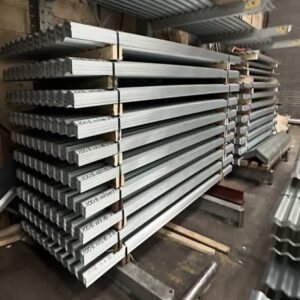
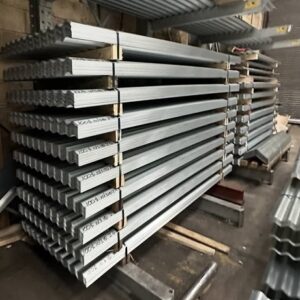
These Tek screws provide a quick, secure fixing solution for ensuring watertight roofs. They are frequently used with our 8ft (2.4m) corrugated tin roofing sheets to create strong metal-to-metal connections across roof installations.
No. The drill point is designed to cut through metal only, driven into wood, it loses its bite almost immediately and won’t hold. Use a sheet-to-timber Tek screw for any fixing into purlins, battens, or other timber.
The screw can struggle to drill cleanly through and may strip out before it’s fully seated, leaving a weak, unsealed fixing. For heavier-gauge overlaps, a longer or heavier-duty sheet-to-sheet screw rated for that thickness is the safer choice.
No, the same screw works for both. What changes is spacing and pattern, not the fastener itself: end laps generally need closer spacing than side laps to keep the joint sealed along its full width.
It’s bonded directly onto the screw shank during manufacture, so there’s nothing to fit separately, or that can come loose before installation. It compresses against the sheet as the screw is driven home to form the seal.
Once removed, the hole and washer seal are compromised, so reusing the same screw in the same hole isn’t recommended. Fit a fresh screw, and if it’s going back into the same hole, expect a slightly looser fit than the original.
There’s no single fixed figure since it depends on sheet profile and local wind exposure, but a common approach is one screw per corrugation along the lap, checked against the sheet manufacturer’s fixing guidance for your specific profile.
Reviews
There are no reviews yet.