
Please Call Before Collecting
£9.55 ex. VAT
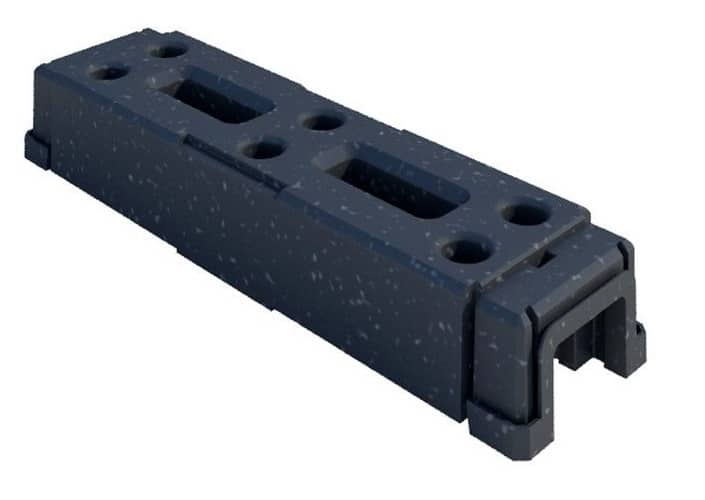
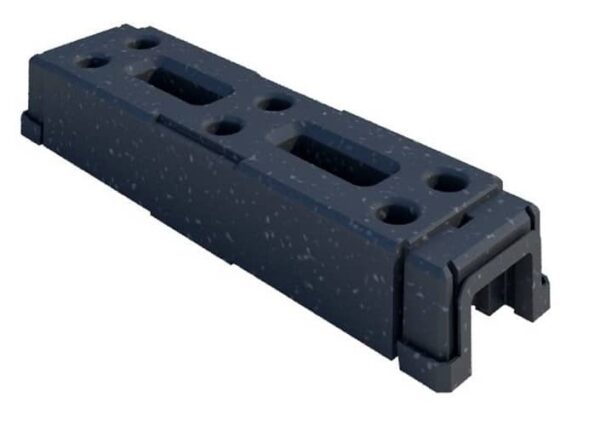
Recycled thermoplastic rubber feet that hold temporary fence panels firmly in place on almost any surface. Each base weighs 16kg and measures roughly 770mm (L) x 195mm (W) x 122mm (H), with six slots to suit panels, gates and stabilisers fitted with standard 38mm tube. Moulded grab handles make it a one-person lift, while underside forklift channels speed up bulk handling. The low-profile design reduces trip hazards, and the hard-wearing recycled construction shrugs off rain, frost and UV. Supplied in black. One foot is required per-panel.
A fence is only as stable as what’s holding it down. These bases are designed to keep a temporary perimeter upright through wind, knocks and everyday site traffic, without the weight penalty or disposal hassle of concrete blocks.
Made from 100% recycled thermoplastic, each foot is compression-moulded as a single piece, so there are no weak seams to split or crack over time. The six slots accept the standard 38mm tube found on Heras-style panels, meaning you can mix panels, pedestrian gates and stabiliser braces along the same run and rearrange the layout whenever the job changes.
Practical details matter on site, and these cover them: handles at each end for a secure carry, forklift channels underneath for moving a stack at once, and a flat, low profile that sits flush to the ground to cut down on trip risk. When the job’s finished, hose them off and stack them in the van or yard ready for the next one.
| Specification | Detail |
| Weight | Approx. 16kg |
| Length | Approx. 770mm |
| Width | Approx. 195mm |
| Height | Approx. 122mm |
| Material | 100% recycled thermoplastic |
| Colour | Black |
| Slots | 6 access points |
| Tube compatibility | Standard 38mm fence tube |
| Handling | Grab handles + forklift channels. |
Construction and groundwork sites, festivals and outdoor events, car parks, sports and recreation grounds, civil engineering and utility works, schools, and domestic or landscaping projects. Anywhere a temporary perimeter needs to go up quickly and stay put.
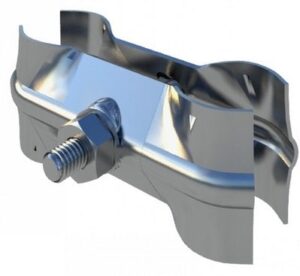
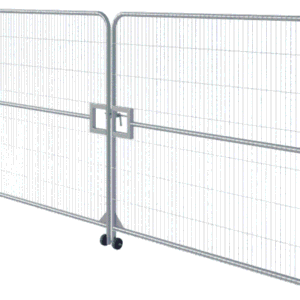
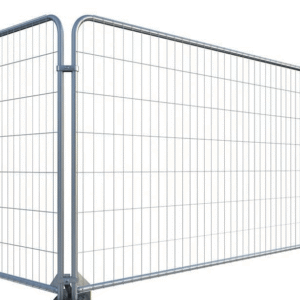
Pair these feet with Heras fence panels (3.45m x 2m) and join your run together with Heras fencing clips for a secure, continuous boundary. For exposed or high-wind locations, add a stabiliser brace for extra rigidity.
As a rule, one foot per panel for a straight line, plus an extra foot to close off each end or corner. So a closed five-panel enclosure needs roughly six feet. Gates and stabilisers also each need their own base, so factor those in separately.
Yes. The six slots are arranged so that adjacent panels can meet over a single foot, which is how corners and continuous runs are usually formed. The end of a run is the main case where a foot supports just one panel leg.
The weight and flat base hold well on firm or compacted surfaces. On loose gravel or soft ground, the foot itself still works, but adding a stabiliser brace or soil pins is worth doing for exposed sites or anywhere wind load is a concern.
For general site and event use, 16kg per panel is the standard working setup. For tall hoarding, debris netting or banners that catch the wind, the surface area increases the load, so additional ballast blocks or bracing are recommended to stop blow-over.
It gives you comparable stability without the brittleness, the chips, or the awkward disposal of concrete. Thermoplastic won’t crack in frost the way concrete edges tend to, and it’s cleaner to handle and store.
Yes, the handles make it a manageable single-person lift. Fitting the panel into the slots, though, is easier as a two-person job, since one holds the panel upright while the other seats it.
They’re built for repeated temporary use and hold up outdoors for years. For genuinely permanent boundaries, a fixed fencing system is the better long-term choice, but for anything temporary or semi-permanent, these are ideal.

Reviews
There are no reviews yet.