
Please Call Before Collecting
£3.50 ex. VAT
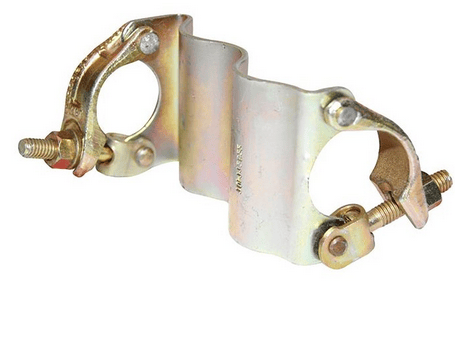
Roofing Couplers (also known as wrigleys or waffle clamps) fasten corrugated roofing sheets directly to steel scaffold tube without any drilling. Built from pressed galvanised steel to fit standard 48.3mm scaffold tubes, each coupler clamps sheets with a 76.2mm corrugation pitch and a combined thickness of up to 3.0mm. Manufactured to BS 1139 and EN 74, they’re the standard fitting for temporary roofs on construction sites, refurbishments, and agricultural buildings where a quick, removable weatherproof cover is needed without altering the tube or the sheet itself.
When you need to keep a section of roof, scaffold platform, or working area dry while the job underneath is exposed, a roofing coupler is what holds the corrugated sheeting to the scaffold frame. Rather than drilling through the tube or sheet, which weakens both and isn’t reversible, the coupler clamps around the tube and grips the sheet between its two pressed-steel halves, using the natural shape of the corrugation for grip. Tighten it down with a scaffold spanner, and the sheet is held firm; loosen it, and the whole roof comes apart for reuse on the next job.
They’re a fixture on temporary roof scaffolds, weather canopies over extensions, and short-term agricultural cover, and they turn up just as often on smaller DIY jobs where someone needs a few sheets held to a simple tube frame without buying a full clamp system.
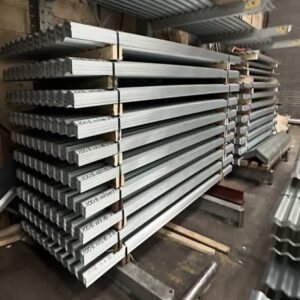
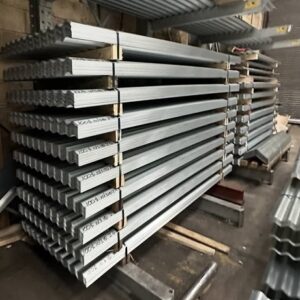
This roof coupler is ideal for securing our 8ft metal corrugated roofing sheets and 10ft metal corrugated roofing sheets, helping you create a watertight tin hat.
| Spec | Detail |
| Type | Roofing coupler (wrigley / waffle clamp) |
| Material | Pressed steel, galvanised finish |
| Tube fitting | 48.3mm scaffold tube |
| Corrugation pitch | 76.2mm |
| Sheet thickness | Up to 3.0mm combined |
| Standards | BS 1139, EN 74 |
| Load rating | Non-load-bearing — for fastening sheets only |
| Drilling required | None |
| Tool required | Scaffold spanner |
| Reusable | Yes |
Drilling through the scaffold tube isn’t something most site managers will sign off on; it compromises the tube for any future job and creates a fixed hole that has to be accounted for every time that tube gets reused. Roofing couplers avoid that problem entirely: the tube goes back into general stock undamaged once the temporary roof comes down.
Compared to strapping or wire-tying sheets in place, couplers give a far more consistent, repeatable fix. Every coupler clamps the same way, so once your crew knows the spacing pattern, sheeting a roof becomes quick and predictable rather than something that depends on how well each tie was pulled.
Position couplers at the high point of a corrugation, not in the valley, that’s where the clamp gets proper purchase on the sheet rather than just squeezing air. As a minimum, use two couplers per sheet, one at each end; for longer sheets or anywhere exposed to strong wind, add a third in the middle.
Make sure the scaffold tube running through the top of the coupler is itself properly fixed into the wider frame before you start clamping sheets to it, a roofing coupler holds the sheet to the tube, but it does nothing to hold that tube in place if the surrounding structure isn’t secure.
These couplers are designed to go through multiple jobs, not just one. After taking a roof down, give them a quick check for bent jaws or a stripped thread on the tightening bolt before they go back in the kit, a coupler that’s been over-tightened repeatedly is the most common one to fail to grip properly next time out. Store them dry; galvanised pressed steel resists rust well, but components left damp and stacked together for long periods will eventually start to corrode at the contact points.
No, the clamping action relies on the 76.2mm corrugation pitch to grip properly. Box profile, trapezoidal, or other non-standard profiles won’t seat correctly and may not hold securely, even if the coupler physically fits over the sheet.
No. They’re non-load-bearing fittings intended purely to hold sheeting in place; they’re not a substitute for properly engineered structural couplers anywhere the scaffold needs to carry weight.
Work on two per sheet as a baseline (one at each end), then add a third per sheet down the middle if the sheets are long, the location is exposed, or you’re expecting strong wind during the hire period.
No, they’re sized specifically for standard 48.3mm scaffold tube, which is the size used across most UK scaffolding systems. They won’t clamp securely on a different diameter.
Yes, that’s standard practice at a join, but check the combined thickness of both overlapped layers stays within the 3.0mm limit. Two heavier-gauge sheets overlapped at once can occasionally exceed it.
A standard scaffold spanner is all that’s needed, no specialist tools. Avoid using power tools to tighten them, as over-tightening can deform the jaws and reduce how well they grip on future jobs.
Reviews
There are no reviews yet.