
Please Call Before Collecting
If you’ve been on the tools for any length of time, you’ll know that “working at height” is one of those phrases that gets thrown around a lot on site, usually right before someone tells you to put your harness on. But how much do you actually know about what the law says, and what it means for your day-to-day work? For most tradespeople, the honest answer is: enough to get by, but not much more.
That’s a problem, because falls from height are still the biggest cause of workplace deaths in the UK. Every year, dozens of workers lose their lives falling from ladders, roofs, scaffolds and platforms, and construction and trade work make up a huge chunk of those incidents. The good news is that the regulations covering this are actually pretty straightforward once you strip away the jargon. This guide breaks it down in plain English, so you know exactly where you stand.
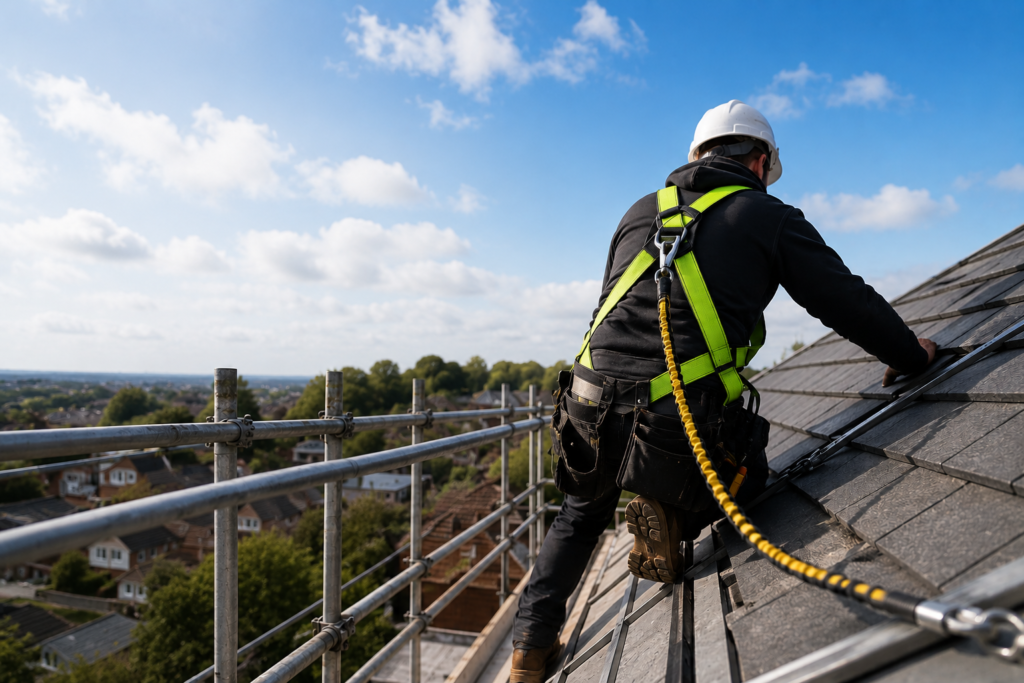
The main piece of legislation is the Work at Height Regulations 2005, often shortened to WAHR. It applies across England, Scotland and Wales, and it’s enforced by the Health and Safety Executive (HSE). If you’re an employer, self-employed, or you control any work at height, even if that just means telling a subcontractor to get up on a roof, these rules apply to you.
The regulations haven’t changed much on paper since 2005, but here’s the bit that catches people out: the HSE’s expectations around how you demonstrate compliance have moved on considerably. Having a ladder and a hard hat isn’t enough anymore. Inspectors increasingly want to see paperwork, risk assessments, inspection records, and training evidence, and they’ll treat missing documentation as a red flag, even if your kit looks perfectly safe.
This is where a lot of tradespeople get caught out. There’s no minimum height that triggers the rules. It’s not about being three metres up or thirty; it’s about whether a fall from where you’re working could cause injury. That means:
All of these count as work at height under the law. A quick job doesn’t get you off the hook; the regulations are clear that duration doesn’t reduce the risk. A five-minute task carries the same legal duties as a week-long one.
Rather than a list of rigid rules, the regulations set out a hierarchy of control that’s meant to shape how you approach any job involving height:
The point of this hierarchy is that PPE and harnesses should be your last line of defence, not your first. If you’re reaching for a harness before you’ve asked whether the job could be done differently, you’re starting in the wrong place.
Before any work at height begins, the regulations require:
There’s a persistent myth that ladders have effectively been banned by health and safety rules. They haven’t. Ladders remain a perfectly legal option for low-risk, short-duration tasks; the regulations are clear that low-risk jobs don’t need the same level of planning as high-risk ones. The key is matching the equipment to the job: a ladder for a quick, straightforward task is fine; a ladder for extended, awkward, or heavy work usually isn’t.
The consequences for ignoring these regulations aren’t small. The HSE can issue improvement notices demanding fixes within a set time, or prohibition notices that stop work immediately. Beyond that, prosecutions can lead to unlimited fines, and in the most serious cases, imprisonment for individuals, including company directors. Even where no one is hurt, missing edge protection or inadequate planning has resulted in six-figure fines for businesses. It’s a reminder that this isn’t just about ticking a legal box; it’s about protecting the people doing the job.
If you’re unsure where your current practices stand, ask:
If you’re hesitating on any of those, it’s worth sorting out before the next job starts, not after an inspector asks.
Good documentation and planning only get you so far if the equipment itself isn’t up to the job. Whether that’s a well-maintained ladder, a properly rated harness, or the right access platform for the task, having reliable, correctly specified equipment is a core part of staying compliant, and of staying safe. It’s worth treating your equipment choices with the same seriousness as your risk assessments, because on-site, the two go hand in hand.
Working at height will always carry risk. But with the right planning, the right equipment, and a clear understanding of what the law actually asks of you, it’s a risk that can be properly managed, job after job, without cutting corners.