
Please Call Before Collecting
If you’ve driven past a building site, a music festival, or even a house getting a loft conversion, you’ve seen it: those metal, mesh-panelled fence sections standing on square feet, linked together to form an instant boundary. Most people in the trade just call it “Heras fencing,” after the company that makes it, though you’ll also hear it called “temporary fencing”, the more general term for the same type of product.
But familiarity doesn’t always mean understanding. Plenty of site managers, landscapers and even seasoned contractors end up over-ordering, under-ordering, or missing the small details that actually make a temporary fence line compliant and secure. So let’s break down what Heras fencing actually is, how it works, and why it’s non-negotiable on virtually every site, big or small.
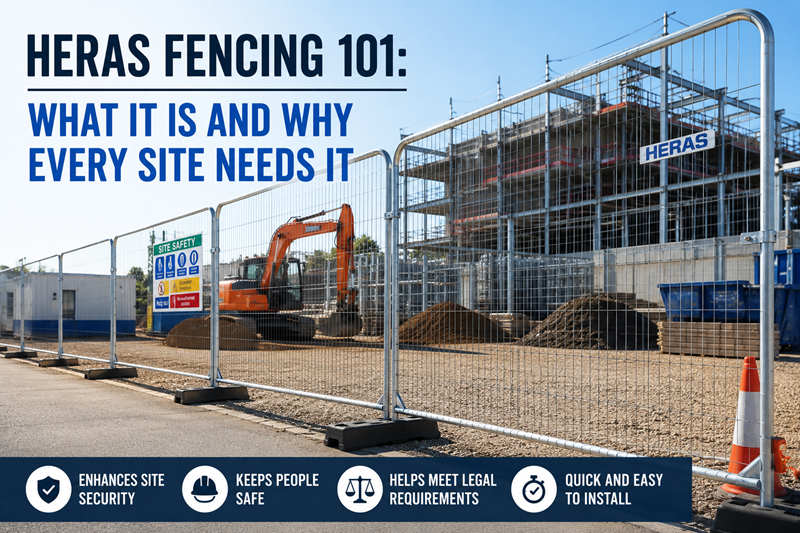
Heras is the name of a Dutch manufacturer that’s been producing temporary fencing since the 1930s, and their products have been a fixture on UK sites for decades. The name is often used interchangeably with “temporary fencing”, the broader term for this type of galvanised steel mesh panel fencing system, designed for quick, secure, non-permanent installation.
The panels themselves are simple in principle: a rectangular steel frame, usually around 3.5 metres wide and 2 metres tall, with a tight mesh infill welded across the middle. Each panel slots into a heavy rubber or concrete foot block, and neighbouring panels are joined together with steel couplers (sometimes called clips). No digging, no concrete footings, no permanent fixings, the whole thing stands under its own weight and is held rigid by the coupled panels on either side of it.
That’s the real genius of the system. Because it doesn’t need to be fixed into the ground, it can go up on tarmac, concrete, grass, gravel, or uneven ground, and it can go up fast. A team can enclose a decent-sized plot in a morning and take it all down again just as quickly once the job’s done.
Construction sites are the obvious answer, but Heras-style fencing turns up in more places than you’d think:
Because the panels are modular, you’re never locked into a fixed footprint. Need to extend the perimeter as the job grows, or shrink it once part of the site is handed back? Just add or remove panels.
It’s tempting to see temporary fencing as a box-ticking exercise, but there are three solid reasons it belongs on every site from day one.
A few practical points worth knowing before you order:
Heras fencing has earned its place as the default choice for temporary site security because it does exactly what’s needed without unnecessary complication: it goes up fast, comes down fast, and does a genuinely good job of keeping people out and materials in while it’s there. Whether you’re securing a major construction project, running a weekend event, or just protecting a skip and some scaffolding outside a house extension, getting the perimeter right is one of the simplest ways to reduce risk on any job.
At Mays Direct, we supply Heras fencing and the full range of site perimeter and security products, including anti-climb panels, site hoarding, crowd barriers and traffic management equipment, in trade quantities or single units, with no minimum order restrictions. If you’re planning a project and aren’t sure how many panels or what accessories you’ll need, get in touch and we will advise you of how best to work it out.