
Please Call Before Collecting
Walk into any builder’s merchant or scroll through any access equipment website, and you’ll be met with row after row of ladders, tall ones, short ones, ones with platforms, ones that fold in half. If you’ve ever stood there wondering which one you actually need, you’re not alone. It’s one of the most common questions we get asked at Mays Direct, and honestly, it’s a fair one. Get it wrong, and you’re either lugging around something far too bulky for a simple job, or worse, stretching and overreaching on something that’s not tall enough to do the job safely.
The good news is that the decision usually comes down to a handful of straightforward questions: how high do you need to go, what are you standing on, and how much space have you got to work with? Let’s break it down.
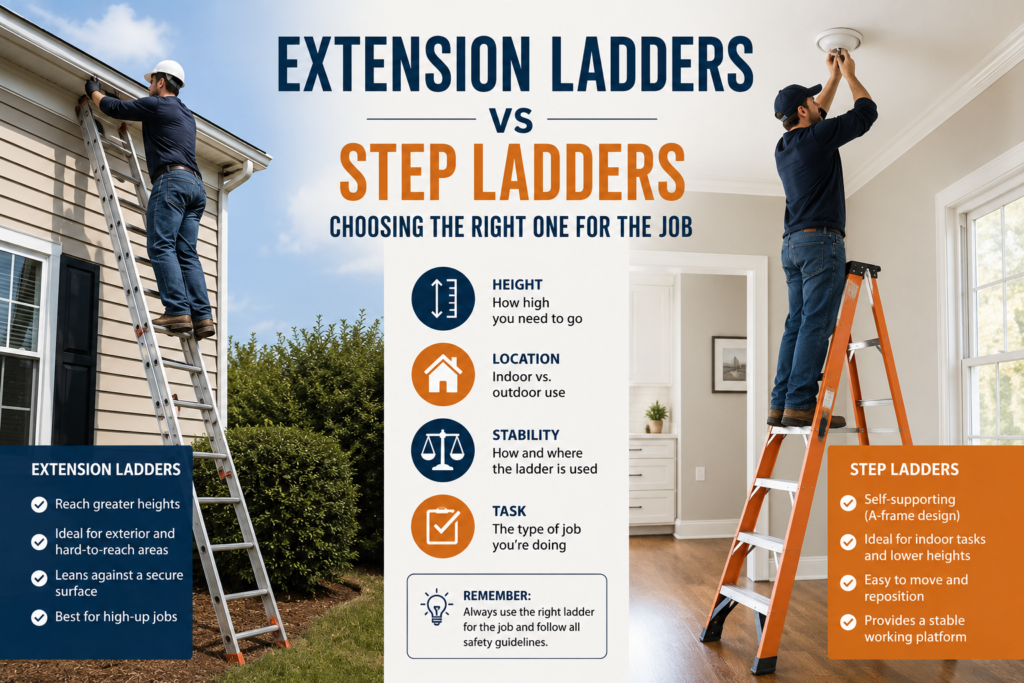
At their core, both ladder types do the same basic job: they get you off the ground and within reach of whatever you’re working on. But they’re built for very different situations.
A step ladder is self-supporting. It stands on its own four feet without needing to lean against anything, which makes it ideal for jobs where there’s no wall or sturdy surface nearby, such as changing a lightbulb in the middle of a room, working on a ceiling, or painting a fence panel that’s freestanding. Step ladders are typically shorter, more compact, and quicker to set up and move around, which is exactly why they’re the go-to choice for a huge range of indoor and light outdoor tasks.
An extension ladder, on the other hand, needs something to lean against, a wall, a gutter line, or the side of a building. As the name suggests, it extends, meaning you can adjust its height to suit the job, from a modest reach up to two or three storeys depending on the model. These are the ladders you’ll see propped against houses for guttering work, roof inspections, window cleaning on upper floors, or general access to anything that’s genuinely high up.
So, in short: if you need to work away from a wall, or the job doesn’t involve leaning against anything, a step ladder is usually your answer. If you’re trying to reach real height and there’s a suitable surface to lean against, an extension ladder is the way to go.
This sounds obvious, but it trips more people up than you’d think. It’s tempting to buy the tallest ladder available “just in case,” but that’s not always the safest, or most practical, choice.
For most household jobs indoors, a step ladder in the 3 to 8 tread range will cover you comfortably. For loft access, high ceilings, or reaching the top of a stairwell, you’ll want something at the taller end, or a specialist stepladder designed for those awkward stair situations.
For outdoor work, gutters, fascias, roof lines, and upper-storey windows, an extension ladder is generally the better tool, and getting the length right matters. As a rule of thumb, you want the ladder to extend at least a metre above the point you’re working at, so you’ve got something secure to hold onto as you step off at the top. Too short and you’re stretching dangerously; too long and it becomes unwieldy to manoeuvre and store.
Surface and surroundings matter just as much as height. Step ladders need a flat, stable, level surface to stand on; they’re not designed for uneven ground or slopes. If you’re working outdoors on paving, decking, or a lawn that isn’t quite level, you’ll need to take extra care or consider a step ladder with adjustable feet.
Extension ladders rely on a stable base and a secure resting point at the top. That means checking the ground at the base is firm and even, and that whatever you’re leaning against, a wall, fascia board, or gutter, can actually take the weight and won’t give way. Guttering, in particular, is notorious for looking sturdier than it is, so where possible, lean the ladder against the wall itself rather than the guttering.
If you’re a tradesperson working at height regularly, it’s worth thinking beyond a single ladder and considering what you’ll need across a typical week. Many professionals keep both a sturdy step ladder for quick, everyday jobs and a good-quality extension ladder for anything involving real height. It’s also worth thinking about material, aluminium ladders are lighter and easier to transport, while fibreglass options are non-conductive, which matters if there’s any chance of working near electrics.
For DIY users, it’s less about having every option and more about matching the ladder to the jobs you’re actually likely to do. There’s no point investing in a heavy-duty extension ladder if your work is mostly indoor painting and shelf-hanging, a solid step ladder will serve you far better and be much easier to store.
Whichever type you choose, a few basics apply across the board. Always check that the ladder is rated for the weight you (and any tools) will be carrying. Inspect it before each use for damage, loose fittings, or worn feet. Never overreach, if you can’t comfortably reach something, move the ladder rather than stretching. And where possible, have someone footing the ladder or aware of what you’re doing, particularly for extension ladder work at height.
That’s exactly what we’re here for. At Mays Direct, we stock a range of extension ladders, step ladders and access equipment suited to trade and DIY users alike, all built to current safety standards. If you’re not sure which ladder suits your project, give our team a call on 01243 767080 or drop us an email at sales@maysdirect.co.uk; we’re always happy to point you in the right direction before you buy, not just after.