
Please Call Before Collecting
If you’ve ever stood in a builders’ merchant staring at a wall of access equipment, wondering whether you actually need a full scaffold tower or whether a set of trestles will do the job, you’re not alone. It’s one of the questions we get asked most often here at Maysdirect, and honestly, there’s no single right answer; it depends entirely on what you’re doing, where you’re doing it, and how high you need to go.
So let’s break it down properly, without the jargon, so you can make the right call before you spend your money.
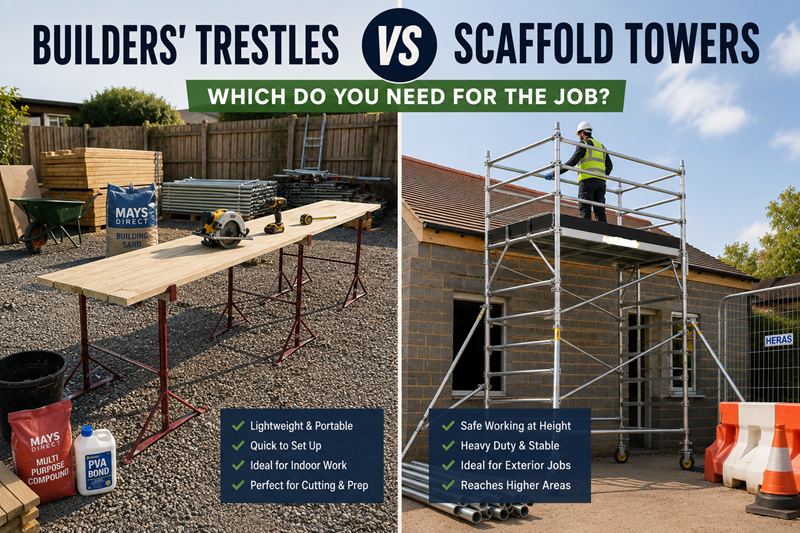
Builders’ trestles are the simple, foldable A-frame supports you’ll have seen in almost every trade van at some point. Pair two (or more) trestles with a scaffold board or staging board across the top, and you’ve got yourself a stable working platform. They’re lightweight, quick to set up, and brilliant for low-level jobs.
Scaffold towers, on the other hand, are modular structures built from frames, braces, platforms and (usually) castor wheels. They’re taller, sturdier, and designed for working at greater heights, often several metres off the ground, with guard rails and toe boards built in for safety.
Both do the same fundamental job: they get you off the ground so you can work safely. But how they do it, and what situations they suit, is where the real differences lie.
Trestles are the go-to choice for a huge range of everyday jobs. If you’re painting a ceiling, plastering a wall, hanging wallpaper, or doing first-fix electrics in a domestic property, trestles paired with a staging board will usually get you exactly where you need to be, typically up to around 2.5 metres, depending on the trestle height and how many risers you stack.
The big appeal is speed and flexibility. You can set a pair of trestles up in a couple of minutes, move them across a room in seconds, and pack them flat into a van at the end of the day. There’s no assembly manual, no bracing to double-check, and no need for a second pair of hands (though it never hurts).
They’re also considerably cheaper than a tower, both to buy and to store, which makes them a sensible investment if you’re a sole trader or a small team working mostly indoors on standard ceiling-height jobs.
The catch? Trestles are only rated for certain heights and loads, and they’re not designed for use above roughly 4.5 metres under the Work at Height Regulations 2005 guidance without additional precautions. They also rely on you using proper staging boards, not random planks of wood, and setting them up on a firm, level surface. Used outdoors, on uneven ground, or up high, trestles quickly stop being the right tool.
Scaffold towers earn their keep the moment a job goes higher, gets more exposed, or needs a proper enclosed platform to work from safely. Think guttering, roofline work, external rendering, high ceilings in commercial units, or any job where you’ll be up there for hours rather than minutes.
The built-in guard rails and toe boards mean towers meet the higher standard of protection required for elevated work, and because the platform is fully enclosed, you’re not relying on your own balance and a board, you’ve got a proper working area with room to move, set down tools, and stay stable.
Towers on castors also let you reposition the whole structure without climbing down each time, which is a genuine time-saver on long runs of guttering or fascia work. And because they’re modular, you can build them up or down to match the job, whether that’s 3 metres or 8 metres.
The trade-off is obvious: towers take longer to erect, need more storage space, cost more upfront, and crucially- need to be assembled correctly. An incorrectly built tower is a serious hazard, so if you or your team aren’t PASMA trained (or don’t have someone on site who is), that’s something to factor into your decision. Most reputable suppliers, we included, would always recommend proper training before regular tower use.
If you’re weighing it up on site, here’s a simple way to think about it:
Most tradespeople end up owning both, because most tradespeople end up doing both types of job. Trestles live in the van for the day-to-day plastering, painting and first-fix work. The tower comes out for the bigger external jobs, loft conversions, or anything where working at height regulations demand a higher standard of protection.
If you’re only going to invest in one right now, think honestly about what your last ten jobs actually needed, that’ll tell you more than any spec sheet will.
And if you’re still not sure, get in touch with the team at Maysdirect. We’d rather talk you through the right choice for your job than sell you something that’s overkill, or worse, not up to the task.