
Please Call Before Collecting
If you’ve ever stood at the start of a project trying to work out how to secure your site, you’ve probably come across the same two options over and over again: Heras fencing and site hoarding. Both do a similar job on paper, they keep people out, keep your site secure, and help you stay on the right side of health and safety rules, but they’re really quite different products, and picking the wrong one can end up costing you time, money, or both.
At Mays Direct, we get asked this question a lot, so we thought it was worth breaking down exactly what separates the two, and how to figure out which one actually suits your job.
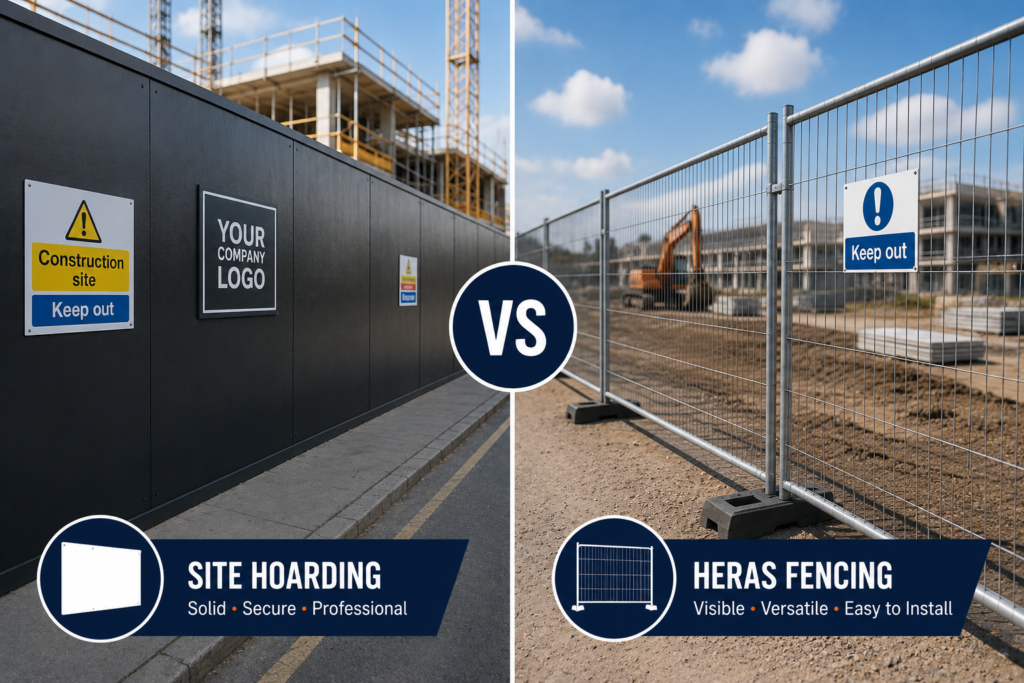
Heras fencing is the mesh panel fencing you’ll see around almost every construction site in the country. It’s made up of galvanised steel panels, usually around 3.5 metres wide and 2 metres tall, connected together with couplers and held upright with weighted feet or stabilisers. The name has stuck as the generic term for this style of fencing, even though “Heras” is technically a brand, a bit like how people say “Hoover” instead of “vacuum cleaner.”
The big appeal of Heras fencing is speed. A team can put up hundreds of metres of it in a single day, and taking it down again is just as quick. It’s lightweight, fully reusable, and because the panels interlock, you can easily reconfigure the layout as your site changes shape over the course of a project. It’s also see-through, which some people view as a downside (more on that below) but which also means it doesn’t block sightlines for site traffic or create blind spots.
Heras fencing tends to be the go-to for shorter-term jobs, roadworks, events, and general perimeter security where the priority is getting a barrier up fast and taking it away just as easily when the job’s done.
Site hoarding is the solid alternative. Instead of open mesh panels, you’re looking at full, solid boards, usually timber, steel, or occasionally UPVC, that create a continuous, opaque barrier around a site. Think of the tall painted or branded panels you see wrapped around building sites in town centres, especially anywhere near pedestrians or busy roads.
Because hoarding is solid, it does a lot more than just mark a boundary. It blocks the site from public view entirely, cuts down on dust and noise escaping the site, and gives you a surface you can brand, paint, or use for signage. It also tends to feel more substantial and permanent, which matters on sites that will be active for many months or where public perception of the project is important.
The trade-off is that hoarding takes longer to install, generally costs more, and isn’t as easy to reposition once it’s up. It’s a bigger investment, but for the right project, it earns its keep.
This is often the deciding factor for a lot of our customers. Heras fencing, particularly when fitted with anti-tamper couplers, does a solid job of deterring casual intruders; the welded mesh design makes it hard to get a foothold, and it’s visible enough that trespassing is obvious to anyone passing by. However, because it’s not solid, it doesn’t stop people from seeing what’s inside, which on some sites is exactly the problem.
Site hoarding, being solid and typically taller, gives you a stronger physical and visual barrier. If your site contains valuable materials, plant, or equipment, or if you simply don’t want passers-by getting a look at what’s going on, hoarding is usually the safer bet. Many hoarding systems can also be reinforced further with anti-climb features or topped with additional security measures if the site warrants it.
Budget is always part of the conversation, and it’s one area where the two options diverge quite a bit. Heras fencing is the more affordable option, both to buy and to hire, and because it’s reusable across multiple jobs, it tends to work out cheaper over time if you’re a contractor moving between sites regularly.
Hoarding costs more upfront, largely due to materials and installation time, but for long-running projects, it can still be the more sensible option. A site that’s active for a year or more will get far more value from a hoarding system than from fencing that needs constant maintenance, cleaning, or replacement over that same period.
Budget is always part of the conversation, and it’s one area where the two options diverge quite a bit. Heras fencing is the more affordable option, both to buy and to hire, and because it’s reusable across multiple jobs, it tends to work out cheaper over time if you’re a contractor moving between sites regularly.
Hoarding costs more upfront, largely due to materials and installation time, but for long-running projects, it can still be the more sensible option. A site that’s active for a year or more will get far more value from a hoarding system than from fencing that needs constant maintenance, cleaning, or replacement over that same period.
Both options need to meet UK safety standards, and the right choice partly depends on what your site actually requires. Heras fencing used on construction sites typically needs to meet BS EN 13374, which covers temporary edge protection. Local authorities may also have specific requirements around hoarding, particularly on public highways or in town centres, where planning permission or a licence might be needed before you can put hoarding up.
It’s always worth checking with your local council if your site borders a public footpath or road, since hoarding on the public highway usually needs a permit, while Heras fencing generally has fewer restrictions.
There’s no single right answer, it really comes down to your project. As a rough guide:
It’s also worth remembering the two aren’t mutually exclusive. Plenty of sites use hoarding along the public-facing boundary for security and appearance, while using Heras fencing for internal segregation or less visible areas where speed and flexibility matter more.
Whichever direction you’re leaning, we stock everything you need to build a complete, compliant perimeter, from Heras fence panels, feet, and stabilisers to full site hoarding systems, all with fast nationwide delivery. If you’re still not sure which option fits your project best, get in touch with our team. We’re always happy to talk through your site and help you land on the setup that actually makes sense for the job, rather than just the one that sounds good on paper.